Monday, April 30, 2018

Scuba Diving in Maldives


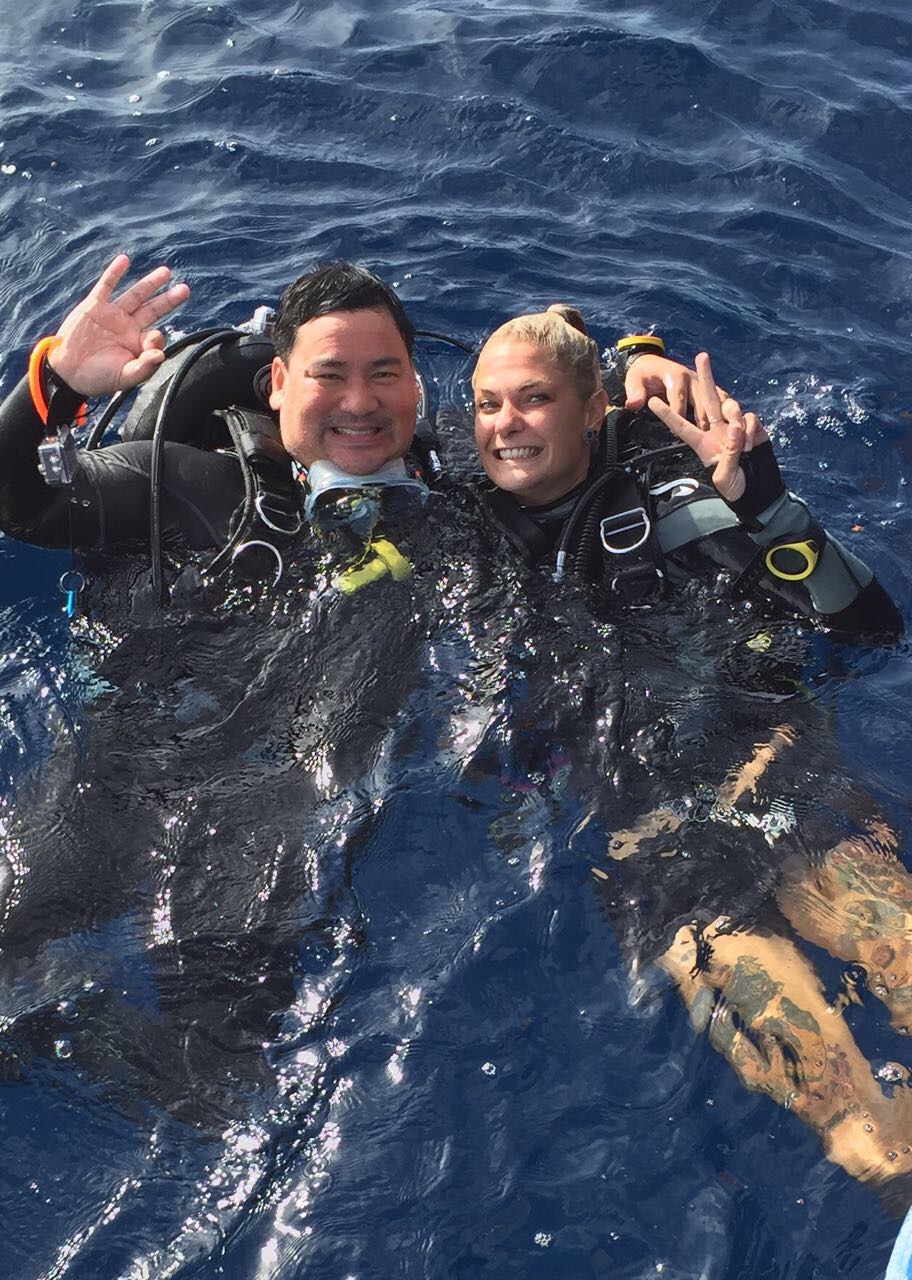
Selina and I recently visited the Maldives and we're glad we decided to do it by scuba diving on a liveaboard. It all started with a plan to scuba dive at Tubbataha Reef off the coast of Palawan--in our own backyard so to speak. Then we found out how expensive the Tubbataha Reef liveaboard packages have become. A comparable Maldives liveaboard package (about one-third across the world from the Philippines in the middle of the Indian Ocean . . . indeed, in the middle of nowhere) costs less than a Tubbataha Reef liveaboard package--inclusive of the roundtrip airfare from the Philippines to Maldives!

By most accounts, the quality of dives in the Maldives is comparable to (some say even better than) those in Tubbataha. So, the Maldives appeared to offer better "value for money" than Tubbataha. And because Tubbataha is just around the corner, we decided to save that liveaboard adventure to a later date.

We were fortunate to arrive in the Maldives in the afternoon. This afforded us a birds eye view of the atolls before the plane landed. It reminded me of Apo Reef, about 50 kilometers west of Occidental Mindoro, except that the Maldives was Apo Reef multiplied 100 times. It's not an archipelago, which connotes a group of island. It's an amalgamation of atolls and sandbars, which barely breach the surface of the Indian Ocean.

An amalgamation of atolls and sandbars barely breaching the surface of the Indian Ocean

With a population of about half a million people (nearly one-third of which is concentrated on Male, the capital of Maldives) and spread over a vast geographical area, I surmised the condition of the marine environment below the surface should still be OK--at least better than anything I have observed in all of my dives in the Philippines to date. Long story short, I surmised correctly! Click on the video link at the end of this blog.

Emperor Leo, our roving home for the week in the Maldives
Before boarding Emperor Leo
This is the dhoni or dive boat of Emperor Leo. It follows Emperor Leo wherever it goes. It is tethered to Emperor Leo when anchored. This is where all our scuba gear is placed and our tanks our filled (air and nitrox). It's got two identical compressors and a nitrox station on board. It transports the entire diving group to specific dive spots from where Emperor Leo is anchored. Most importantly, it picks up the divers after we have surfaced.
A room with a view!
Attention to detail!
Emperor Leo, the dhoni and a typical Maldive resort in the background
Living and dining area . . . fully air-conditioned 24/7
Also serves as the dive briefing room . . . Andrea (Swiss), boat manager and dive master, together with the other dive masters on Emperor Leo, Rico (Maldivian), Victor (Ukranian) and Megan (Canadian)
Upper deck of Emperor Leo with Selina
Selina at Sunrise

With Andrea

With Rico


With Manda, my dive buddy


Michael, a real good sport!


Dinner on an island


Observe the Maldivian God above the setting sun looking down


Our area of coverage was in the middle section of the Maldives. We dove everyday from April 15 (Sunday) to April 20 (Friday), 3 dives a day except on the last day (2 dives only to allow a gap of 24 hours before our return flight). That's a total of 17 terrific dives!

The rightmost column lists our 17 dive locations

Saturday, March 24, 2018

Duck Confit and Pan-Seared Duck Breasts

By Jove, I’ve got it. And I must say using a freshly slaughtered free-range Muscovy duck; otherwise known in the Philippines as “bibe”. We won’t have any of these industrial-grown vacuum-packed leg quarters or breasts. There’s nothing like naturally-grown fowl, cutting up the duck yourself and rendering the skin and fat for the confit. A genuine rendition of the “pasture to plate” concept.

My first attempt was a roasted Peking Duck recipe, which doesn’t work with a Muscovy. You will need a Pekin duck, which has fattier skin. I surmise it is no coincidence that the Pekin duck breed is the one used for the Peking Duck recipe. The good news is, Muscovy is meatier and it’s the duck used by the French for duck confit and pan-seared duck breasts. After what I did today, I would not want my Muscovy any other way.


Image result for muscovy duck
Muscovy duck or bibe. Note the bright red-mask on its face--a distinctive feature of the Muscovy.

After extracting the leg quarters and the duck breasts (folks, you need a really sharp boning knife to get this done properly), I removed all the skin and fat to render the same into duck lard—the all important ingredient in duck confit. Ok, since this is my first attempt at duck confit, I did not have enough duck lard to immerse the leg quarters; therefore, I added extra-virgin olive oil to the duck lard (1 to 1 ratio) to achieve the immersion of the leg quarters. And the leg quarters were not quite completely immersed. Well, they will be on my next attempt, because I’m saving this first batch of duck lard/extra-virgin olive oil mix.

Image result for butchered duck

The low and slow cooking method (225 degrees F for 2.5 to 3 hours) is bound to tenderize the leg quarters of even the toughest free-range duck in all of Central Luzon. The rest is just searing the skin to a crackling crisp. Oh boy, was it crispy—just like the duck confit I had in Antonio's (Tagaytay) or in the chi-chi French restaurant that Moe brought me to in New York City.


Image result for duck confit
Duck Confit

Of course, we still have the duck breasts, which doesn’t quite work the same way as the leg quarters. Fortunately, we have sous vide today to take away the guesswork on the doneness of the breast meat (135 degrees F for 1 hour). Unlike chicken, it’s safe (and more delicious) to eat medium rare duck breasts. It’s similar to filet mignon, which would be a crime to consume well-done. Like the duck confit, the skin-side of the duck breast is pan-seared to achieve that crackling crisp once again!

Image result for pan seared duck breast
Pan-Seared Duck Breast

I did not have the ingredients readily available at the farm to prepare a fruity sauce for the duck. Yes, yes . . . poor planning. Until my next “p to p” rendition . . . lovingly confit to all!

Friday, December 15, 2017

What is it about red convertibles?

During a car show in the San Francisco Bay Area with Uncle Ted Ulanday and, my sweet cousin, Sophie
Barely a teenager yet I couldn't resist a red convertible even then

First Generation Miata, released in the USA in 1990--the year I graduated college at Virginia Tech

Thanks to Mom, I bought one of these (Mazda 323 hatchback, white).
The least expensive model at the Mazda dealership (no AC and no radio) in Burtonsville, Maryland.
It was brand new, economical and very reliable.
It got the job done, bringing me to and from work and wherever I wanted to go on the weekends.
I called her MIO (as if to say, you may not be a Miata but at least you are mine).
And I said to myself, I would get myself a Miata one day.

Nearly 30 years after college, this is the Fourth Generation Miata. It's now (2017) or never!
I could not stand the idea of paying more taxes (increasing in 2018) to purchase this car!
Did I mention that I am turning 50 in a couple of months and may get too fat to fit into a Miata?

So here we are!
Probably my longest running "marshmallow test" to date. Yes, I have succumbed.
The first and perhaps the last unequivocally gratuitous acquisition in my life.
An early morning run from my home in San Juan to the Baguio Country Club in 3.5 hours . . . no kidding!

Sunday, October 15, 2017

A New Beginning for the Endangered Sea Turtles at the Mangal Marine Protected Area


That's the Adan brothers (Romy and Freddy) flanking the spot less than 10 meters from the waterline at high tide along Casabangan Bay (within the Mangal Marine Protected Area or MMPA in Mansalay, Oriental Mindoro) where a sea turtle recently layed her eggs. The second picture is a close-up of the spot--a mundane memento of an otherwise significant event of nature, particularly in Casabangan. This was noted by the MMPA Bantay Dagat Team in the morning of September 6, 2017, which happens to be the birthday of Mom.

It is well-known among the elderly residents of Barangay Don Pedro (Mansalay) that sea turtles were abundant in Casabangan Bay. Most likely, egg-laying of sea turtles in the area was a regular occurrence up to around the 1960s or the time there was a marked influx of human population in the area.

Until a law was passed in 2001 (RA 9147 -- Wildlife Resources Conservation and Protection Act) protecting sea turtles in the Philippines (and until some semblance of enforcement occurred at the local government level more than a decade after the passage of the law), the locals would indiscriminately pick their eggs, catch them for food and leave their shells scattered all over the beach of Casabangan. It's a miracle that a few of these sea turtles had survived the wanton destruction of their kind in Casabangan Bay and appear to be making a comeback just months after commencing the enforcement of the MMPA Ordinance (mid-April 2017).

The point is, there has not been much sea turtle hatchlings or, for that matter, sea turtle egg-laying in Casabangan Bay over the past half-century and certainly none documented like this recent occurrence on September 6, 2017. Maybe it's because there is less disturbance from people in Casabangan Bay as a result of the recent enforcement of the MMPA . . . or maybe we're just lucky that our sea turtles are giving us another chance to enjoy their wonderful presence. Either way, the MMPA is giving the sea turtles (and, in general, a tiny portion of the local marine eco-system) some space to breathe and recover. If  this is an indication or a clue of a possible turning-point, then this is the community's chance to make it right.

It should take about 60 days before the sea turtle eggs hatch. If all goes well, we should witness our first "turtle boil" in Casabangan Bay (since over a half century ago) around the first or second week of November 2017.

Postscript

Subsequent discussions with the Bantay Dagat Team indicate that there may have already been some initial sea turtle hatchlings in Casabangan Bay in the latter part of the 3rd quarter, 2017. They described the sighting as "many small sea turtles floating at the surface of the water that appeared to be dead but quickly submerged when we approached them."

On the week of October 9, 2017, a new member of the Bantay Dagat Team, John Paul, noticed another egg-laying site in the Lalawigan area, which should result in hatchlings between the first and second week of December 2017.

The following video shows what we can expect to see when the eggs hatch. I hope the Municipal Agriculture Team can film Mansalay's own "Turtle Boil".


Sunday, May 21, 2017

Kyoto

After our visit in New York City, Selina and I proceeded to Kyoto, Japan. One of the reasons I chose to fly Philippine Airlines for this particular trip was the fact that PAL flew into Kansai International Airport, which is only about 90 minutes by bus to Kyoto.

We arrived at Kansai at around 8 pm, picked-up our luggage at the baggage claim and proceeded to the bus stops immediately outside the exit. It felt like a domestic flight as I hardly noticed immigration and customs. There are bus personnel that guide tourists to the correct bus--in our case the bus that goes to Kyoto station. We had to change currency to purchase our tickets at the ticket machine, which look like ATMs and are easy to operate--even if you don't understand Japanese. Upon arriving at Kyoto station, a black Toyota Crown taxi appeared like clockwork and we were off to our hotel.

We checked into Hotel M's Est Shijo Karasuma (which I recommend highly; it's central, convenient, safe, clean, cute--warning, the rooms are small--and a great value at less than P3k per night; it just opened in March 2017 and barely 2 months in operation, so the rates may go up soon) at around 10 pm, Wednesday,  May 17. Hassle free! Upon setting foot in Japan, one gets the sense that things work properly here and little is left to chance.


We, on the other hand, made no plans whatsoever other than a clean slate and left our schedule in Kyoto entirely to chance. In short, we decided to just "wing it". Surely not the most efficient itinerary but we had a leisurely pace, which appears consistent with the feel of Kyoto (where you will observe the Japanese still wear their traditional kimono as they go about their daily routine).


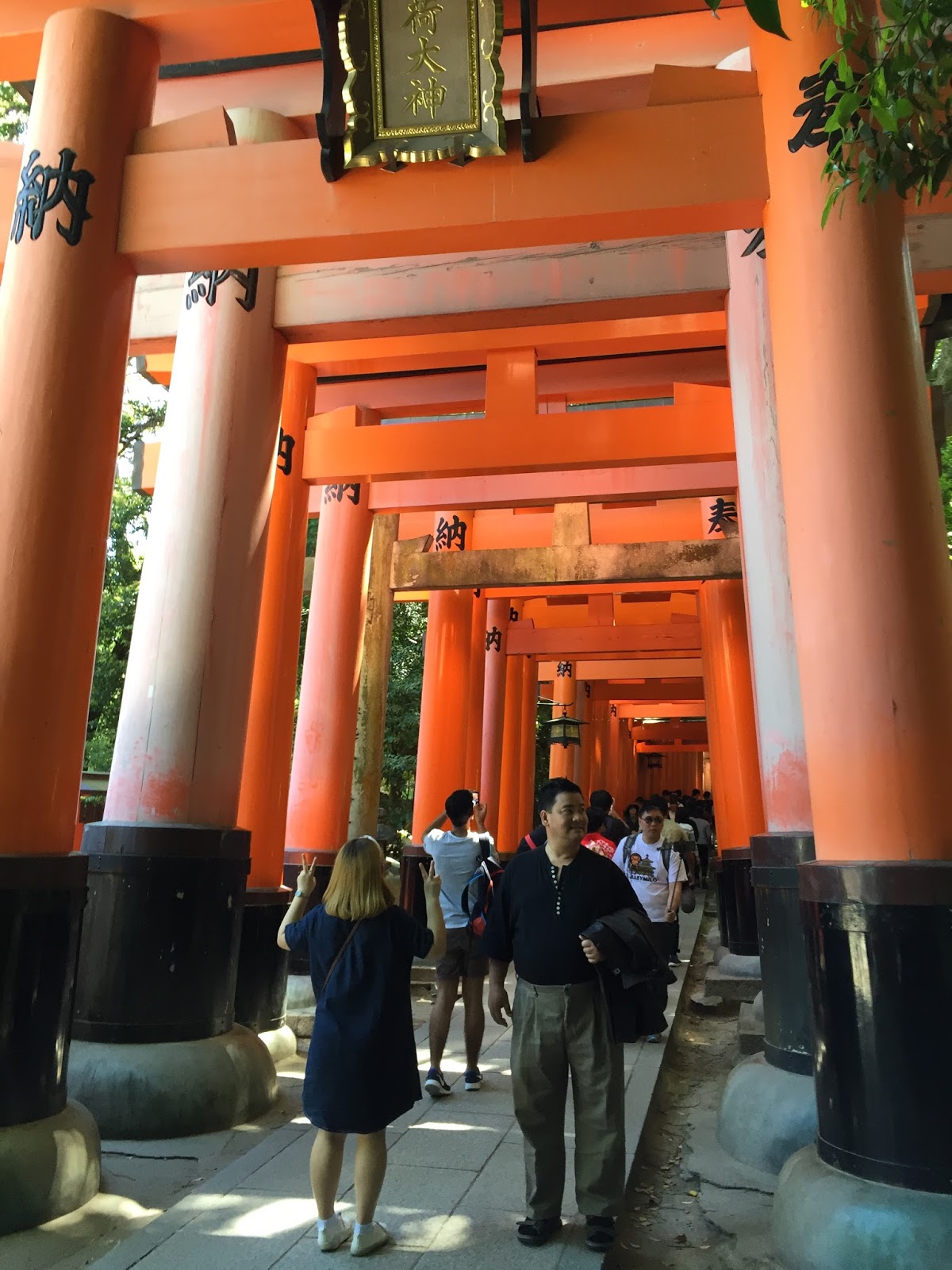
May 18--Fushimi Inari Shrine and Arashiyama area (Tenryu-ji Zen Temple, Sogenchi Garden, Arashiyama Bamboo Grove)


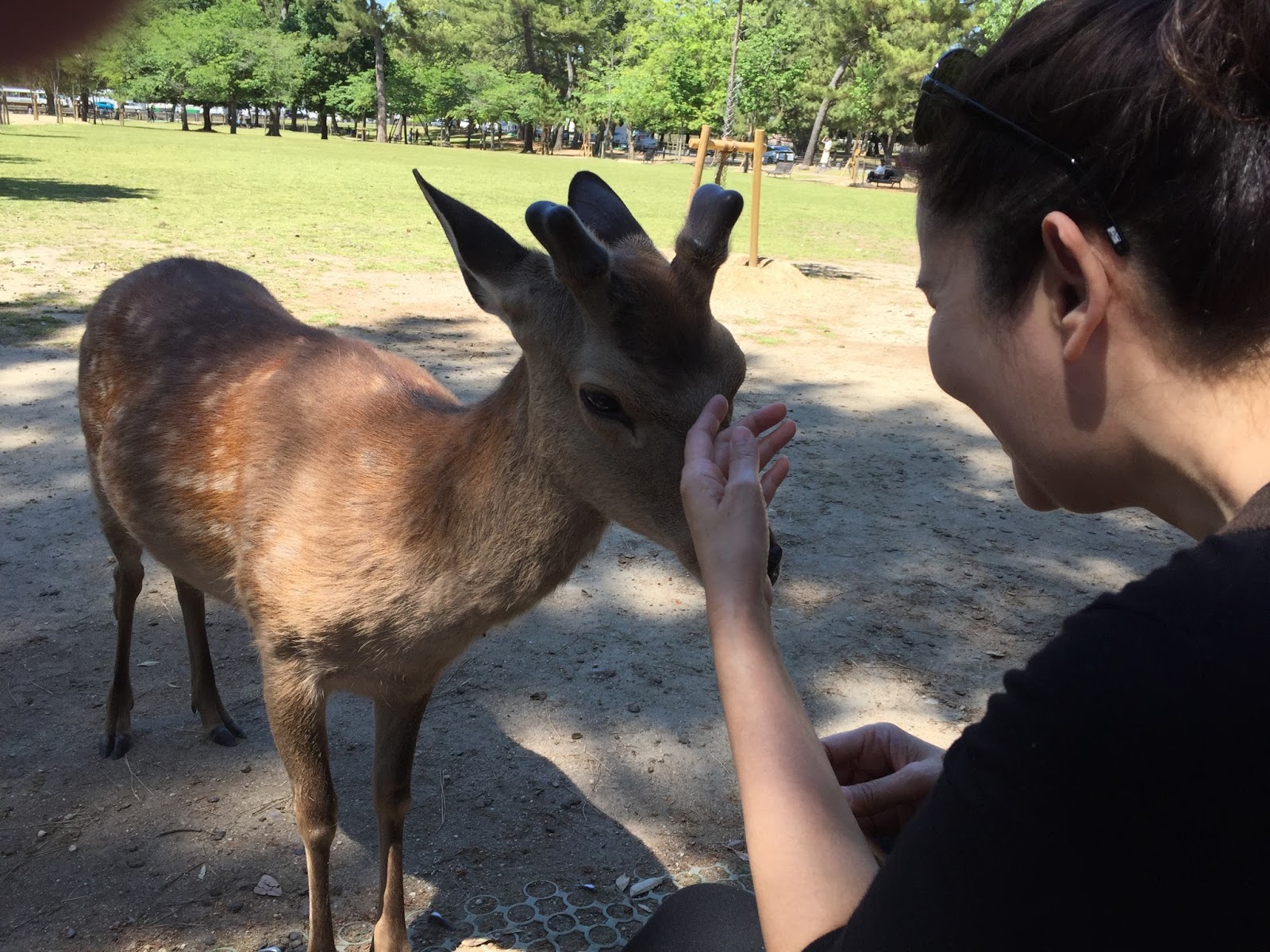
May 19--The Five Storey Pagoda at Nara Park. . .  and the deers!


May 20--Kagonoya (all-you-can-eat shabu-shabu and sushi, Shijo Karasuma Branch, just a few blocks from our hotel). We stuffed ourselves to the point we just returned to our hotel and slept. How terrible is that!

May 21--Nijo-jo Castle and Ginkakuji Temple


May 22--Kinkakuji Temple and Chion-in Temple


At first glance, Kyoto is NOT particularly impressive. Sure, it's relatively NOT crowded for Japan. One does NOT feel rushed in this city. Not as expensive as I expected. It's clean and has a terrific public transportation system. Locals are tolerant and even helpful to tourists.

If you're a foodie, Kyoto might disappoint. Yes, Wagyu beef is available all around town but you can already get nearly the entire quality range of Wagyu beef in Manila. The local diet is mostly carbs (noodles and rice), which is a reminder that Japan is a fundamentally poor country that had to struggle every step of the way to achieve its economic might. Of course, protein like sashimi and Wagyu beef are available but these are NOT daily fare. I would even venture to say that there is a shortage of fruits, which are astronomically expensive--a clear indication of the Japanese government subsidy to the agricultural sector.


Kyoto's distinction is its Imperial pedigree, including it's castles, shrines and temples (a number of which are UNESCO World Heritage Sites), that appear to be located all over the city. Selina and I barely scratched the surface (e.g., we didn't even visit the Imperial Palace or its grounds--not sure if it's even open to the public) during this visit, which is always a convenient excuse to return.